
Introduction
Every day, operations teams in plants, refineries and field locations lose valuable time searching through manuals, tickets and emails to find answers. The information exists, but it is buried in PDFs, SharePoint sites and siloed systems.
Generative AI is the perfect fit for this challenge, but only when it is grounded in trusted, governed data.
FlowAgent by Bizmetric brings the power of Databricks Agent Bricks to the front lines of manufacturing and energy operations. It turns your Databricks Lakehouse into domain‑aware GenAI agents that speak the language of your assets, procedures and performance metrics.
Why “generic” chatbots fail in industrial environments?
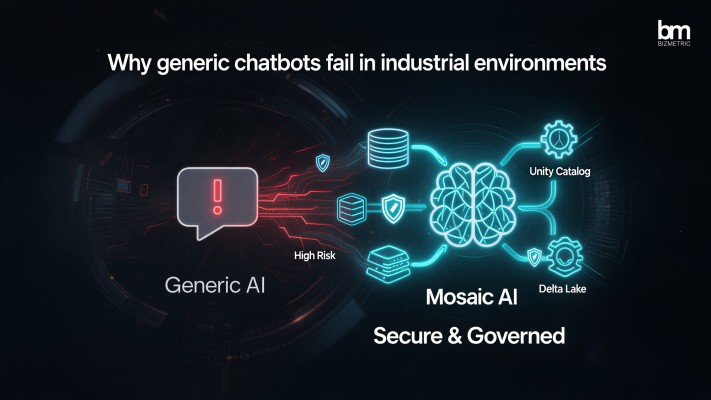
Generic chatbots trained on public data can answer simple questions, but they cannot reliably guide technicians through complex procedures, or reason about real‑time sensor data, alarms and work orders. They also introduce significant risk if not properly governed and audited.
In industrial environments, AI must be grounded in accurate plant data, approved operating procedures and up‑to‑date asset history. It must also respect access rules, protect sensitive information and provide traceability. This is where Databricks Agent Bricks – which sits on top of Mosaic AI as an opinionated, higher-level framework focused specifically on auto-building and auto-optimizing AI agents using your data – combined with Unity Catalog and Delta Lake, provides a strong foundation for secure, enterprise‑grade GenAI.
FlowAgent: GenAI built on your Lakehouse
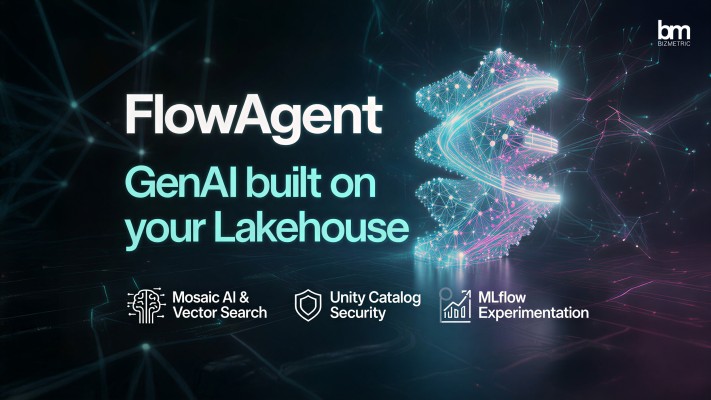
FlowAgent is Bizmetric’s framework for building GenAI operations copilots directly on top of your Databricks Lakehouse. The platform uses Agent Bricks for large language models, vector search and agent orchestration, while the Lakehouse provides governed access to data from historians, CMMS, MES, ERP and document repositories.
As FlowAgent is tightly integrated with Unity Catalog, it can inherit row‑ and column‑level security, ensuring that each agent only accesses data the user is permitted to see. MLflow is used to track prompts, models and evaluation results, enabling controlled experimentation and continuous improvement.
Key FlowAgent use cases for manufacturing and energy
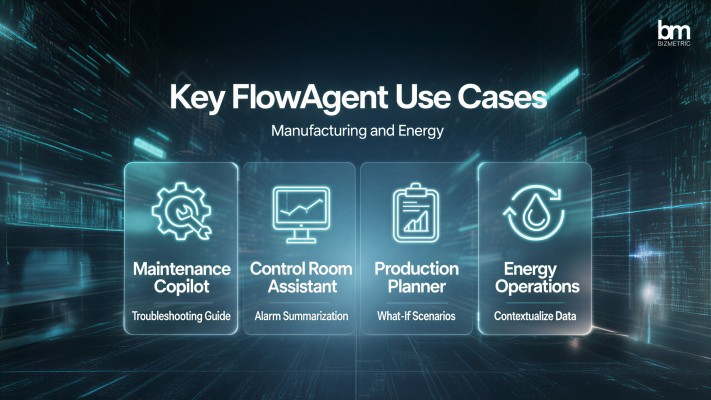
FlowAgent is designed to support day‑to‑day workflows for engineering and operations teams, not just provide a chat interface. Typical use cases include:
-
Maintenance copilot:
Guides technicians through troubleshooting steps by combining SOPs, historical work orders and live telemetry, reducing mean‑time‑to‑repair. -
Control room assistant:
Summarizes alarms, recommends probable causes and surfaces recent incidents and playbooks relevant to the current situation. -
Production planner assistant:
Helps planners evaluate “what‑if” scenarios, access historical performance, and surface constraints across lines, plants or regions. -
Energy operations copilot:
Assists operators and engineers across upstream, midstream and downstream activities by contextualizing production, flow and integrity data with lessons learned and standards.
Architecture: From Lakehouse to agents
At a high level, FlowAgent follows a predictable pattern on Databricks:
-
Ingest and unify data from OT systems, maintenance, quality and documentation into Delta Lake tables, managed by Unity Catalog.
-
Generate embeddings and build an Agent Bricks vector index over curated knowledge bases such as SOPs, incident reports, best‑practice guides and equipment manuals.
-
Use Agent Bricks’ Agent Framework to define tools and workflows (retrieval, calculations, system integrations) that agents can call.
-
Track prompts, models, evaluations and deployment details using MLflow to ensure transparency and repeatability.
This approach lets you start small—such as a single maintenance copilot for one plant—and then expand agents across multiple sites, languages and regions as adoption grows.
Regional relevance: designed for US and global operations
Manufacturing and energy companies running US plants and global sites often deal with complex setups—legacy on-prem systems mixed with cloud platforms, plus teams spread across multiple regions and business units. FlowAgent handles this head-on, supporting diverse users while securely linking to both on-premises and cloud data through Databricks.
The beauty is the flexibility: start with a solid, governed Lakehouse foundation, then layer on FlowAgent to bring real value to technicians, engineers, and control room teams—no matter if they’re in a US facility or halfway around the world.
Getting started with FlowAgent
Bizmetric typically starts with a focused workshop to identify one or two high‑value workflows for a specific plant or asset. From there, a FlowAgent pilot can be implemented on Databricks Agent Bricks that integrates with existing data sources and tools.
If you want to turn your Lakehouse into a set of intelligent, trusted GenAI agents for operations, FlowAgent on Databricks Agent Bricks offers a practical, enterprise‑ready path. Reach out to our teams to schedule a FlowAgent discovery session for your manufacturing or energy operations and we at Bizmetric will be there to help.


Write a Reply or Comment
You must Register or Login to add a comment.